Fashion in Passage
House of Colours transforms Basel's Kunstmeile into a runway without boundaries.
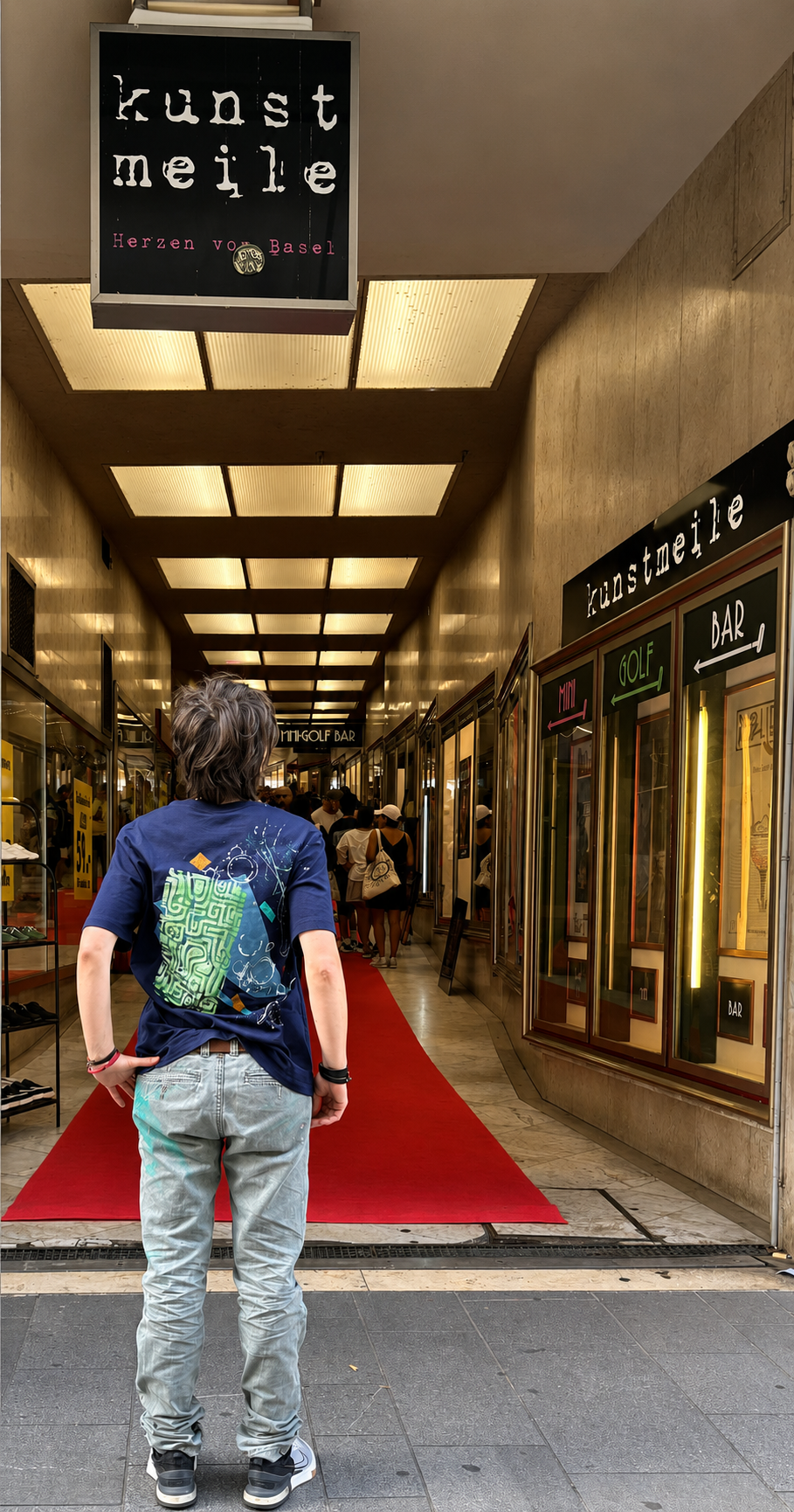
I walked into the Kunstmeile from the top of its narrow passage, where a red carpet ran downhill through a crowd gathered around its edges. Smoke from a machine hung in the air as the DJ played, people mingling as they waited.
The Kunstmeile is a pedestrian stretch in central Basel known for its concentration of galleries, cultural spaces and creative activity.
I popped my head into a side shop; racks of clothes, people changing and busily moving around. Inside, I said a quick hello to Simone Markl, the designer behind fashion brand Syocco Art and owner of Basel art gallery House of Colours. Back across the threshold, the audience, now occupying the runway, talked, danced and sipped.
The crowd was growing as models rehearsed on the red carpet, not yet wearing their runway outfits. Weaving through the people as I went to look for a good spot, towards the bottom of the Kunstmeile, artist Russo Ge was live painting directly onto a lady's dress.
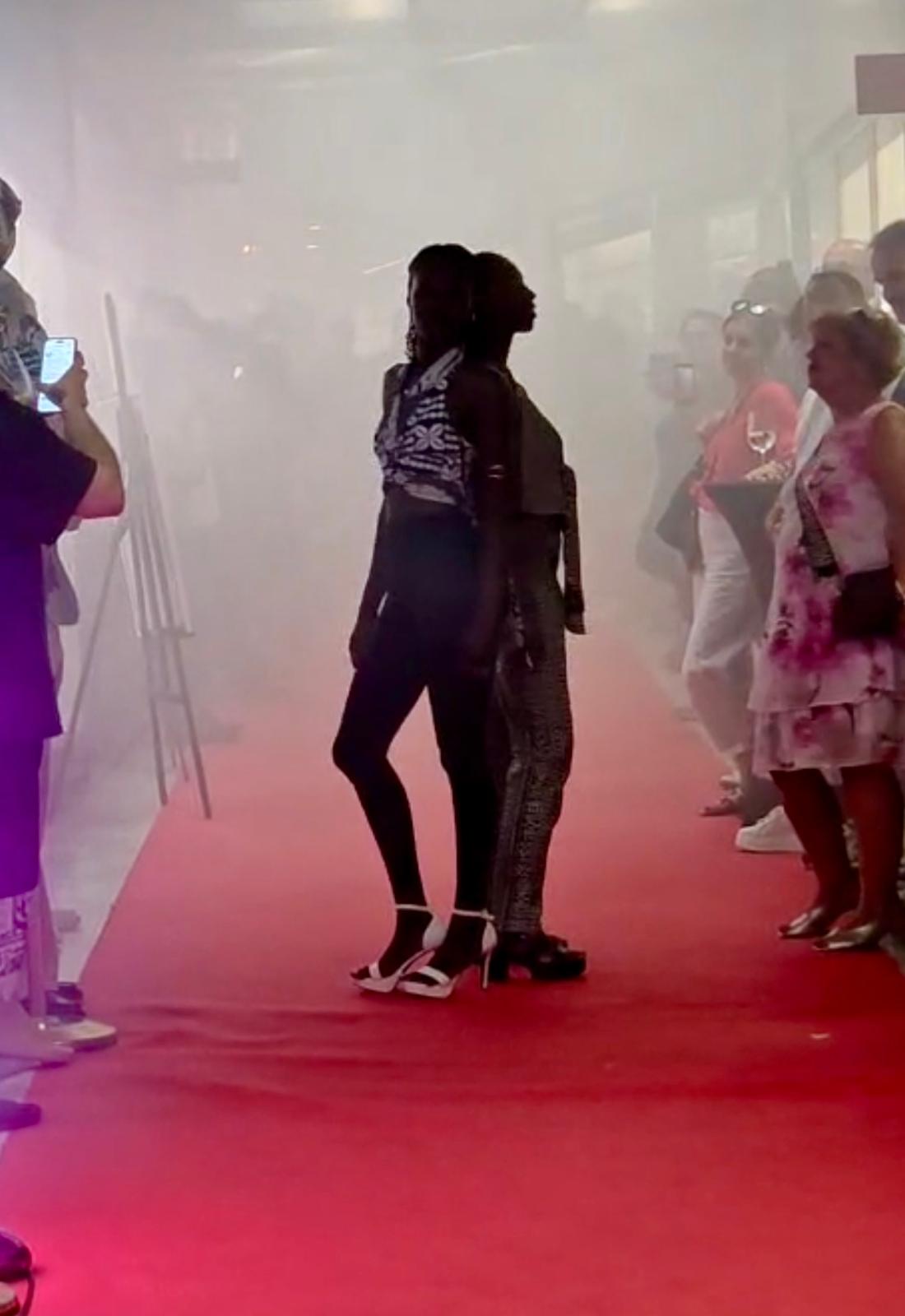
The DJ began hyping up the crowd as the audience started clapping and cheering. Smoke filled the runway as the first model from the Syocco Art collection made a strong entrance, wearing a black-and-white African-print trouser-blazer co-ord, opening her blazer to reveal a bandeau top with a long-tailed bow detail.
The looks that followed continued the collection's bold use of African prints, black and white appearing prominently, broken up with flashes of colour. Two of the pieces played on this contrast particularly well, their left and right sides divided between black and white and vibrant colour, creating a striking contrast as the models moved down the runway.
Simone explained that she bought the fabric and produced her clothes in Dakar, Senegal, and said that
“African fashion is in general with quite bold and vibrant colours, and these fabrics are typical of a lot of African fabrics.
”
Simone Markl's path towards fashion began at the age of 16, when she had two apprenticeships to choose between: herbalism and tailoring. She chose herbalism, though her dream of fashion design remained in the background as she sometimes wondered what might have happened if she had chosen the other path.
Simone told me that she had long held an ambition to attend Dakar Fashion Week. She envisioned that, when she finally went, she would make at least three outfits for herself. When the trip eventually became possible, she said it
“Felt very fated and magical and special.
”
Once in Dakar, she was
“Absolutely mind blown by the amount of patterns and fabrics that were available.
”
Faced with so much choice, she found it impossible to settle on just three outfits and ended up making more than she had intended. Pleased with how they turned out, she decided to show them in her new art gallery, House of Colours, when she returned to Basel. The clothes were well received, and, as Simone put it,
“So that's how it all started.
”

The fourth look on the runway was a blue, black, white, yellow and red printed jumpsuit, with a slim tailored fit through the bottom, high-waisted tapered legs cropped just below the ankle, and elevated with black strappy heels. But this particular jumpsuit carried added significance: Simone had originally made it to wear on her trip to Dakar Fashion Week, making it a particularly special piece within the collection.
It also captured something I thought Simone did especially well: creating pieces that felt joyful without being reserved for special occasions. On the runway, the jumpsuit was elevated with a strappy heel, but its tailored silhouette and easy, wearable shape made it just as convincing beyond the runway. The bold print brought colour and personality to an otherwise classic, versatile cut.
The blue-and-white beaded necklace worn by one of the male models was another look that stayed with me. Worn against his bare chest, the necklace featured a choker with long strands of beads descending down the front, gradually becoming shorter towards the edges. The vivid blue stood out against the black and white, creating a bold and confident look.
When I asked Simone about the current fashion scene in Basel, she pointed to Lilian and the upcoming Black Essence Fashion Show at Paulus Kirche on 12 September, describing it as part of a movement bringing Black and white cultures together in Basel. Simone, who had spent time with the people involved, spoke enthusiastically about the energy surrounding the project. It was clear that, for her, the connections being made between fashion, culture and community were as important as the clothes themselves.
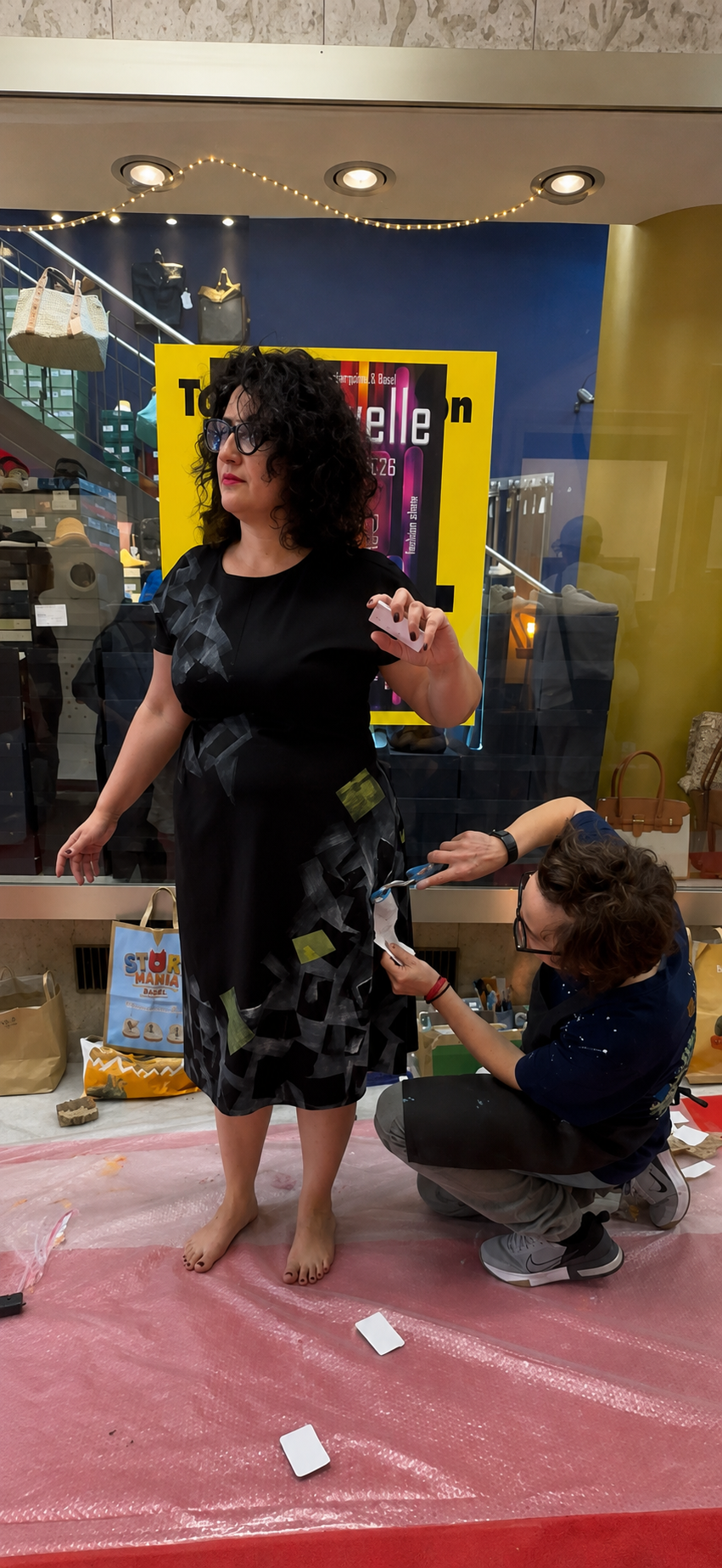
That same blurring of boundaries between fashion and art was present throughout House of Colours. Earlier in the evening, I had watched artist Russo Gè painting directly onto a woman's black dress as a crowd gathered around her, phones raised to capture the process. Later, I found myself on the other side of the crowd, with Russo painting onto my own T-shirt. As she worked, she described the red circle she was painting as her symbol:
“This is my symbol.
”
I had arrived at the Kunstmeile in a plain white T-shirt. I left at the bottom of the passage feeling uplifted and energized, wearing a one-off piece of artwork painted directly onto my clothes. The fashion show had transformed clothing into a way of expressing identity and creativity; by the time I left, I was carrying a little piece of the evening with me.